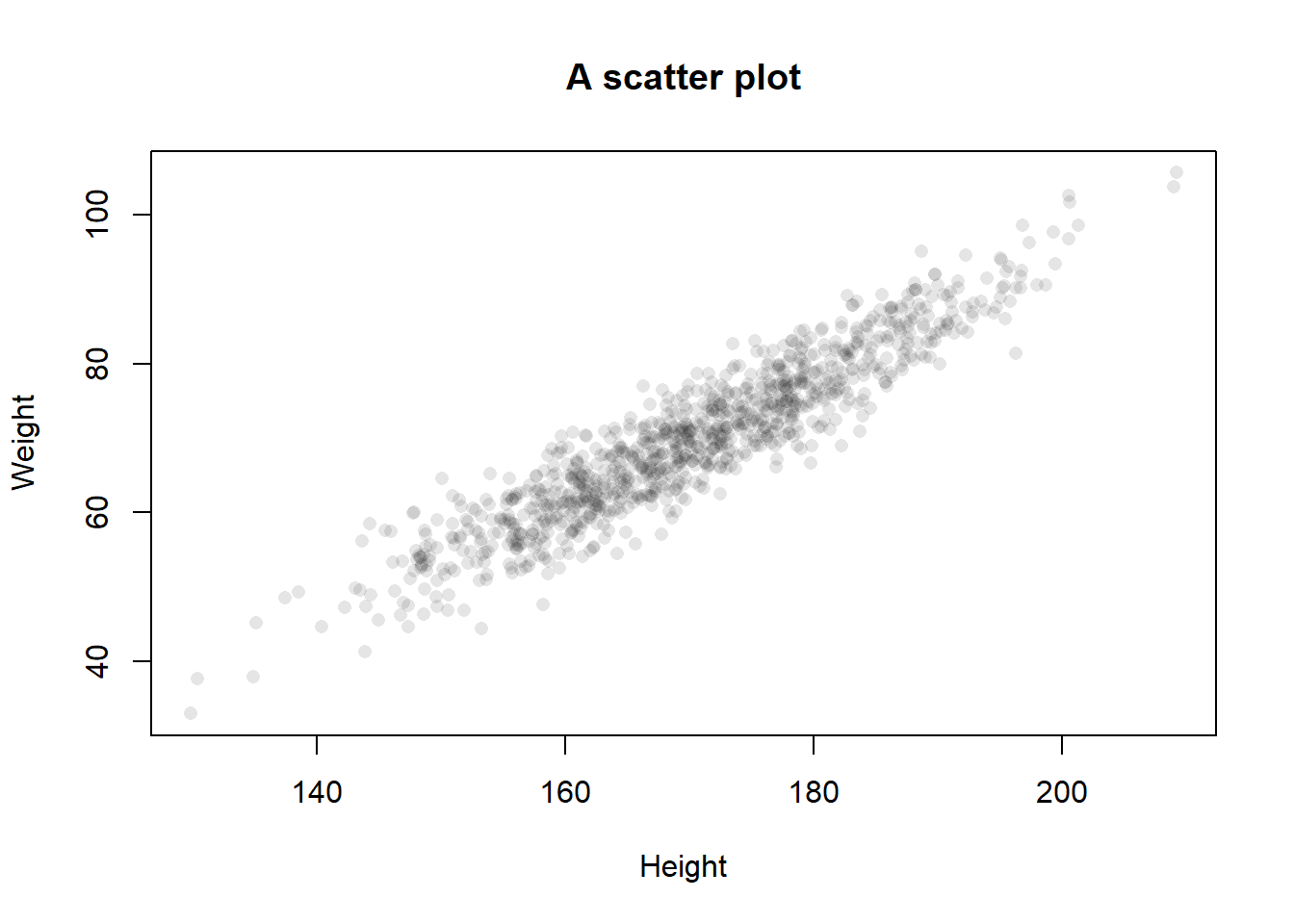
************
Welcome to BayesFactor 0.9.12-4.7. If you have questions, please contact Richard Morey (richarddmorey@gmail.com).

Type BFManual() to open the manual.
************
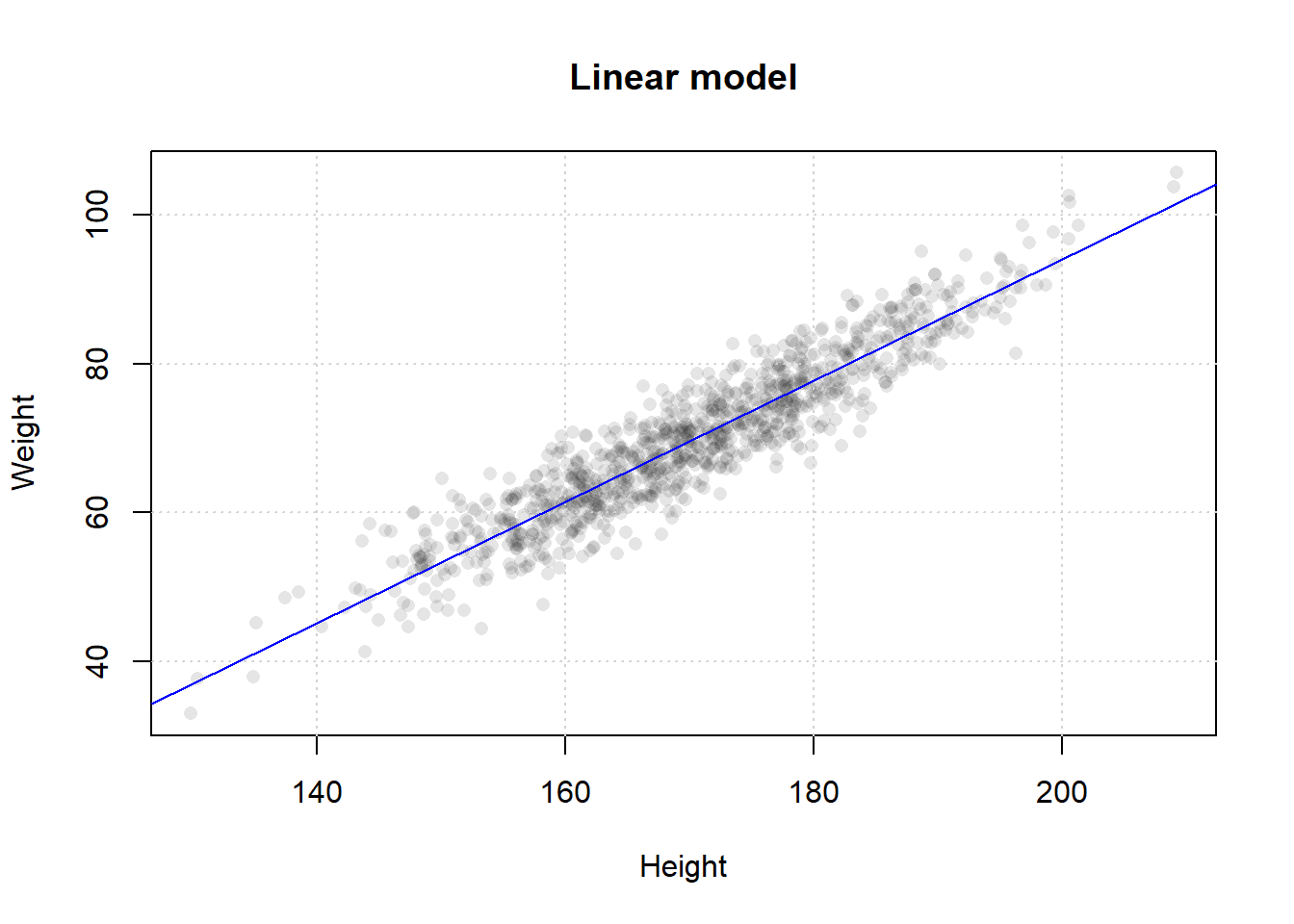
plot(x = pirates$height,y = pirates$weight,main ='Linear model',xlab ='Height',ylab ='Weight',pch =16,col =gray(.0, .1))grid()model <-lm(formula = weight ~ height, data = pirates) # Linear modelabline(model, col ='blue')
Pirate plots
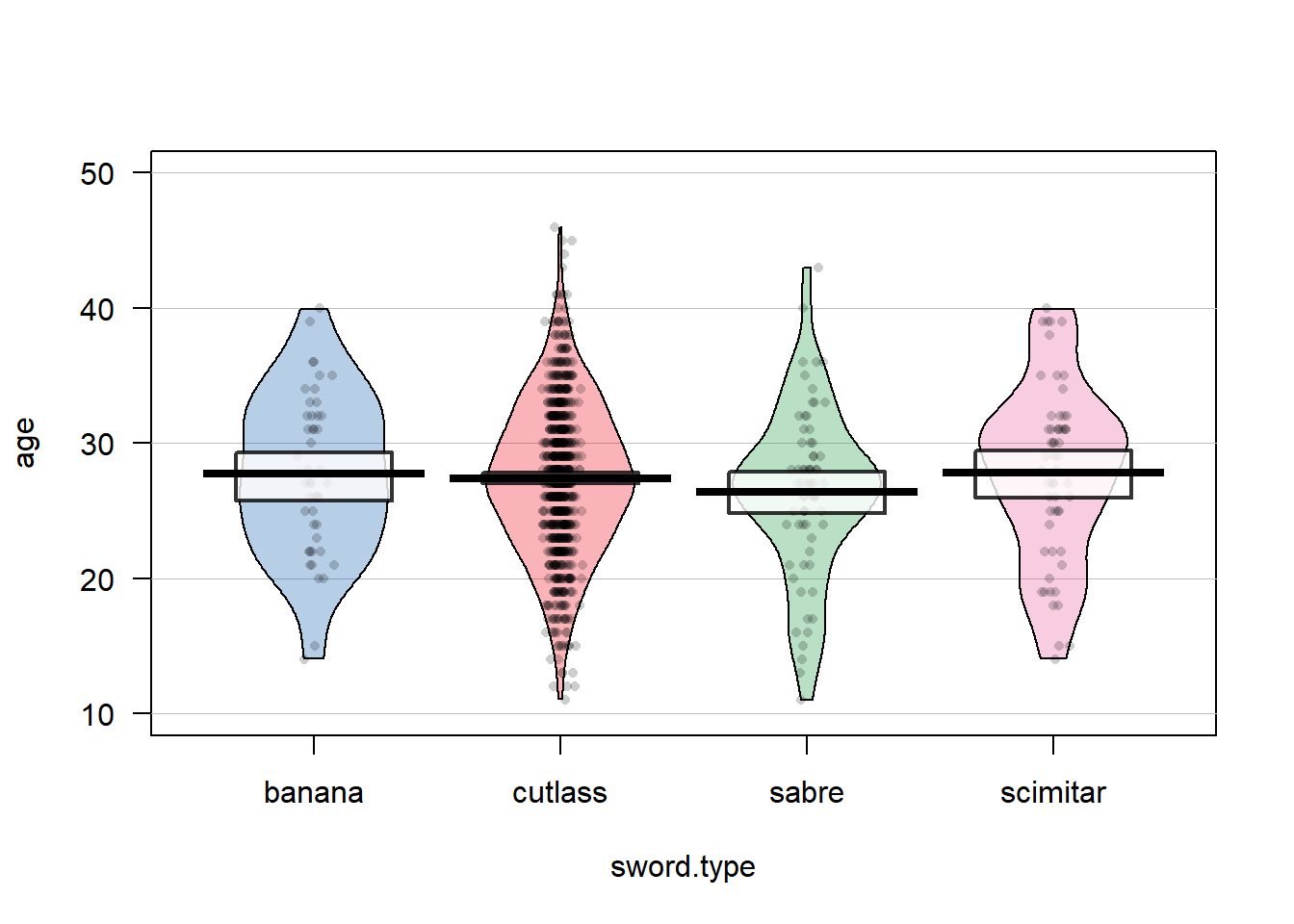
Ages by favorite sword
pirateplot(formula = age ~ sword.type,
           data = pirates)
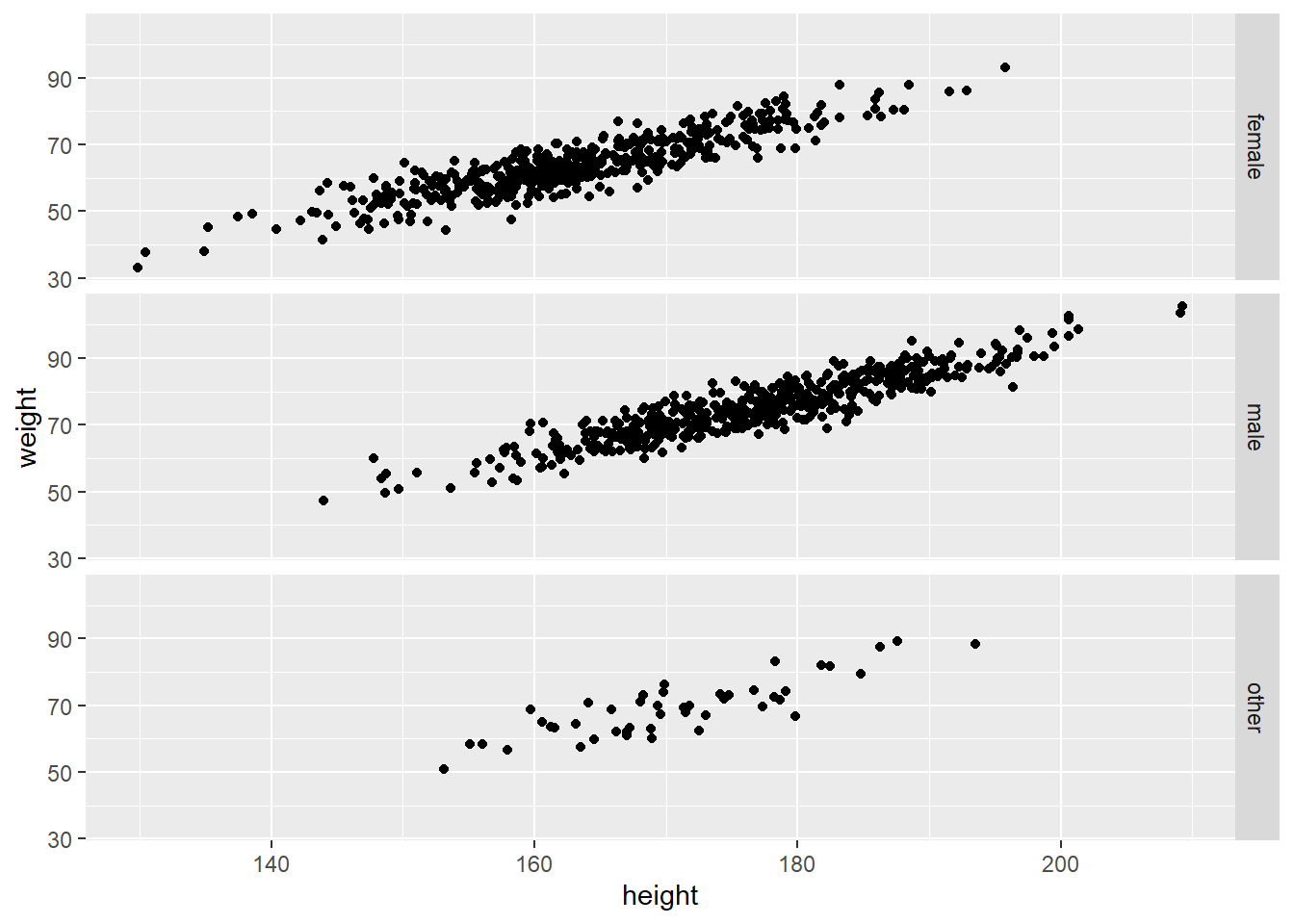
Weight and height vs sex
library(ggplot2)
Attaching package: 'ggplot2'
The following object is masked from 'package:yarrr':

    diamonds
p <-ggplot(pirates, aes(height, weight)) +geom_point()p +facet_grid(rows =vars(sex))
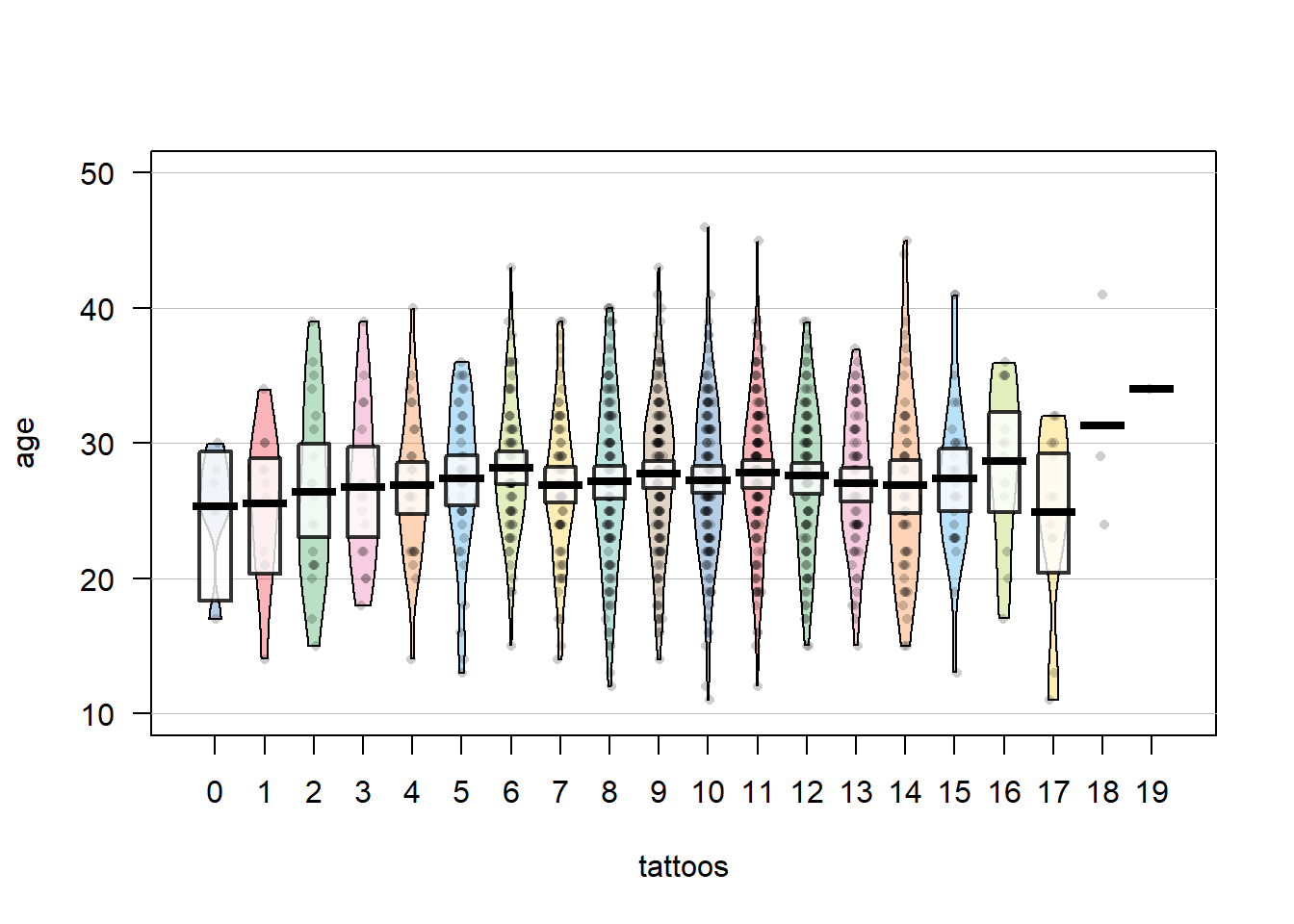
Ages by tattoots
pirateplot(formula = age ~ tattoos,
           data = pirates)
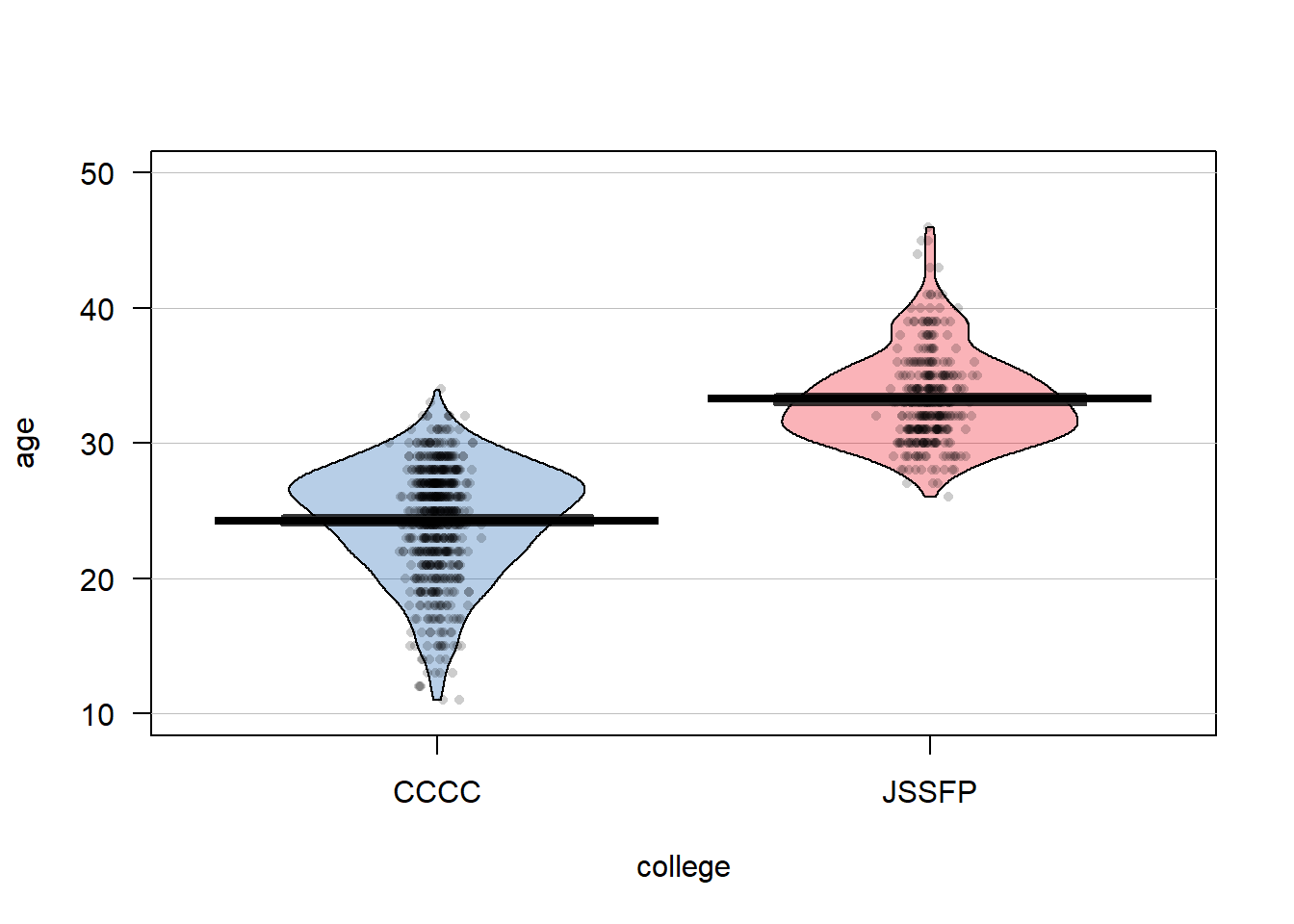
Ages by college
pirateplot(formula = age ~ college,
           data = pirates)
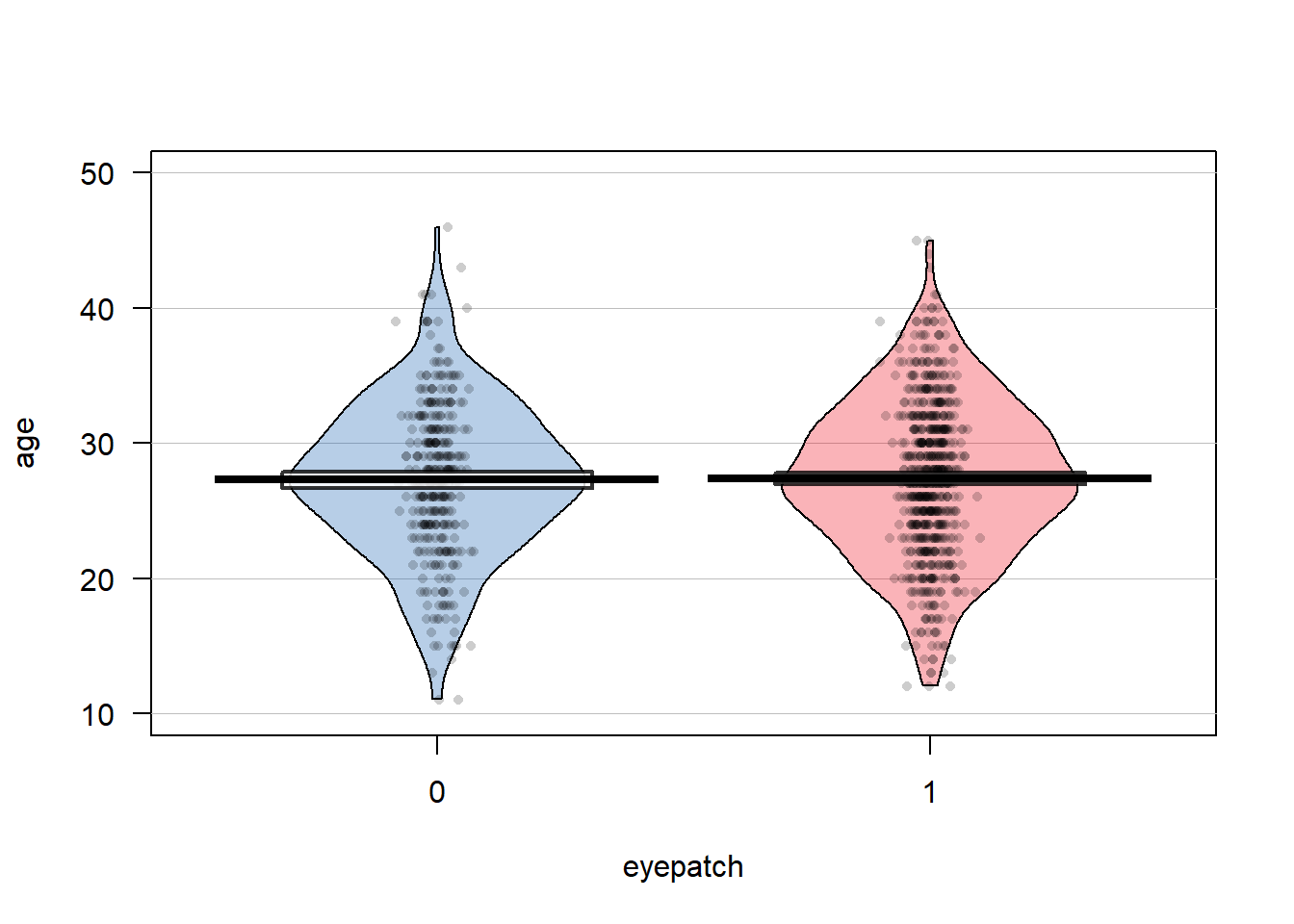
Ages by eyepatch
pirateplot(formula = age ~ eyepatch,
           data = pirates)
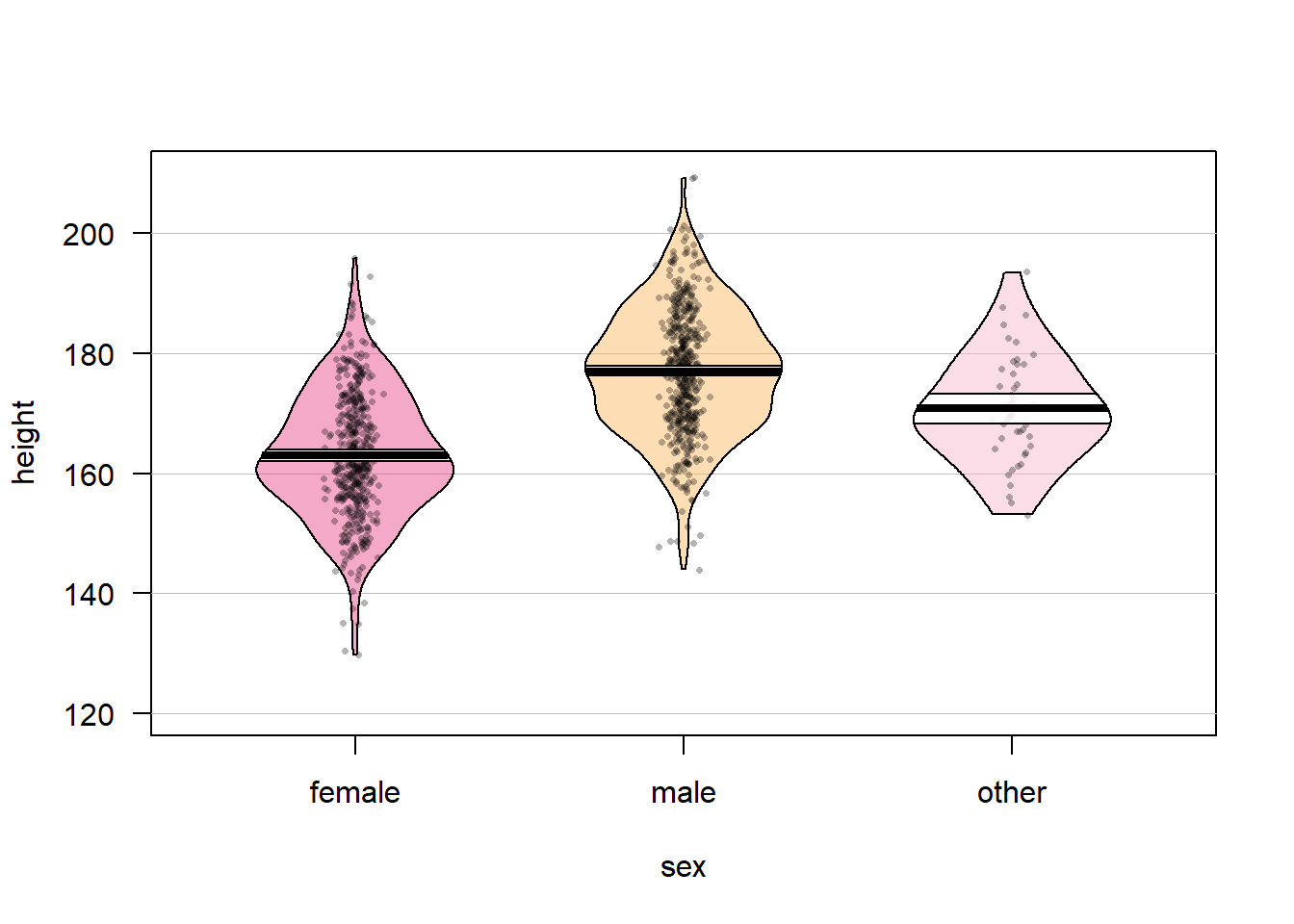
Height by sex
pirateplot(formula = height ~ sex, # Plot weight as a function of sexdata = pirates, pal ="pony", # Use the info color palettetheme =3) # Use theme 3
Height by fav. weapon
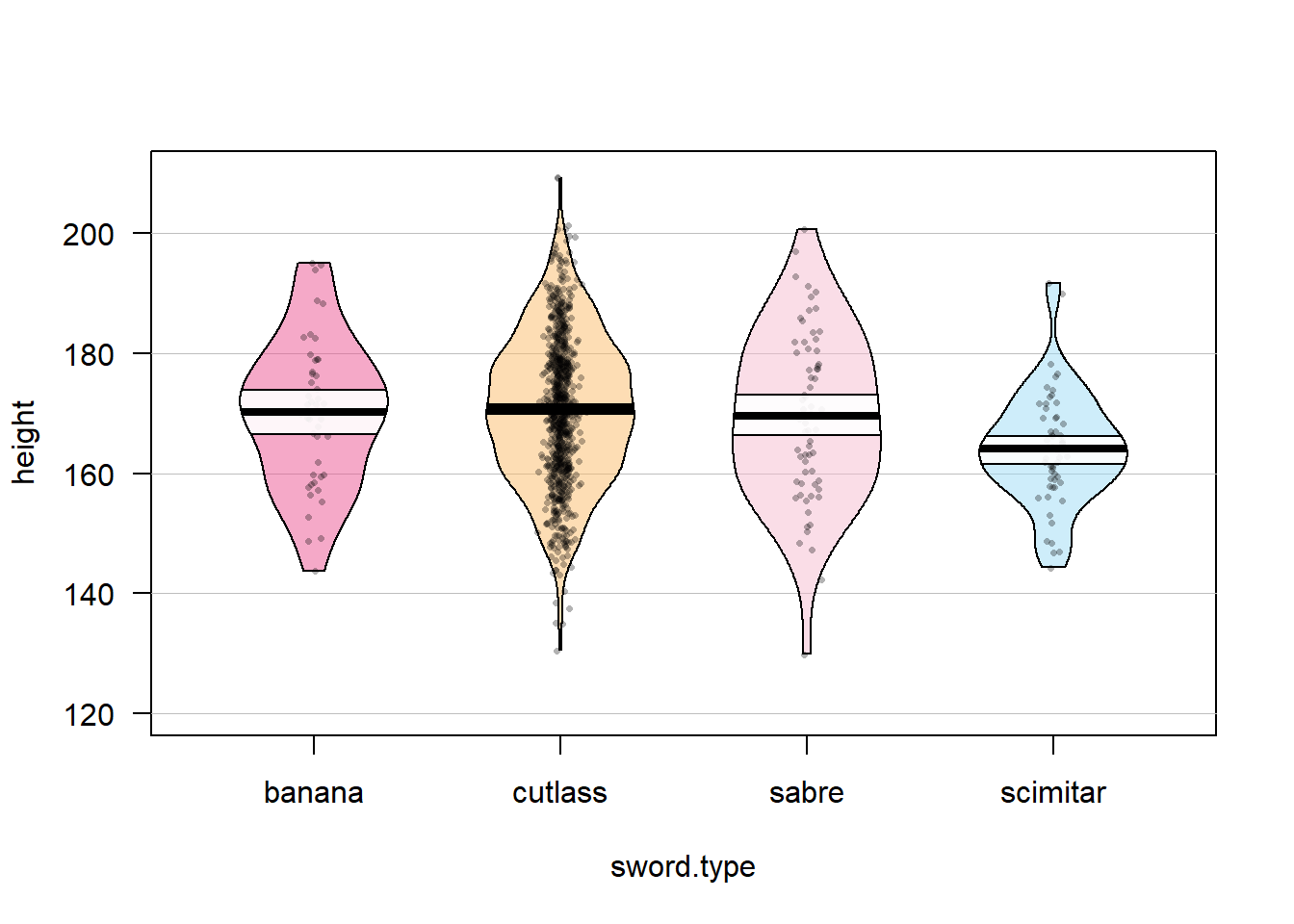
pirateplot(formula = height ~ sword.type, # Plot weight as a function of sexdata = pirates, pal ="pony", # Use the info color palettetheme =3) # Use theme 3
To see if there is a significant difference between the ages of pirates who do wear a headband, and those who do not:
# Age by headband t-testt.test(formula = age ~ headband,data = pirates,alternative ='two.sided')
    Welch Two Sample t-test

data:  age by headband
t = 0.35135, df = 135.47, p-value = 0.7259
alternative hypothesis: true difference in means between group no and group yes is not equal to 0
95 percent confidence interval:
 -1.030754  1.476126
sample estimates:
 mean in group no mean in group yes
         27.55752          27.33484
With a p-value of 0.7259, we don’t have sufficient evidence to say there is a difference in the mean age of pirates who wear headbands and those who do not.
Correllation test
Next, let’s test if there is a significant correlation between a pirate’s height and weight using the cor.test() function:
    Pearson's product-moment correlation

data:  height and weight
t = 81.161, df = 998, p-value < 2.2e-16
alternative hypothesis: true correlation is not equal to 0
95 percent confidence interval:
 0.9232371 0.9396050
sample estimates:
      cor
0.9318938
We got a p-value of p 2.2e-16, that’s scientific notation for p .00000000000000016 – which is pretty much 0. Thus, we’d conclude that there is a significant (positive) relationship between a pirate’s height and weight.
ANOVA testing
Is there a difference between the number of tattoos pirates have based on their favorite sword?
tat.sword.lm <-lm(formula = tattoos ~ sword.type, data = pirates)anova(tat.sword.lm)
Analysis of Variance Table

Response: tattoos
            Df Sum Sq Mean Sq F value    Pr(>F)
sword.type   3 1587.8  529.28  54.106 < 2.2e-16 ***
Residuals  996 9743.1    9.78
---
Signif. codes:  0 '***' 0.001 '**' 0.01 '*' 0.05 '.' 0.1 ' ' 1
Sure enough, we see another very small p-value of p < 2.2e-16, suggesting that the number of tattoos pirates have are different based on their favorite sword.
tat.sex.lm <-lm(formula = tattoos ~ sex, data = pirates)anova(tat.sex.lm)
Analysis of Variance Table

Response: tattoos
           Df  Sum Sq Mean Sq F value Pr(>F)
sex         2     0.3  0.1605  0.0141  0.986
Residuals 997 11330.6 11.3647
Is there a difference between the number of tattoos pirates have based on their sex? The oppossite…
tat.beard.lm <-lm(formula = beard.length ~ sex, data = pirates)an_beard <-anova(tat.beard.lm)message(an_beard)